




Quick Summary: AI is becoming the backbone of how serious investors make decisions, not just an additional feature. This blog covers what AI in stock trading actually means, how it works, the benefits it brings, and the platforms leading the space in 2026. You’ll also find where the risks sit, what trends are coming next, and how to build your own AI trading tool if that’s the path you’re on.
Picking stocks used to come down to gut instinct, a few spreadsheets, and whatever your broker told you. That approach doesn’t hold up anymore. Markets move faster, data comes from more places, and the traders winning today are the ones who can process all of it before the moment passes.
That’s where AI-powered stock trading fits in, and it’s far from the naive approach of “a computer selects stocks for you.” It uses machine learning algorithms based on years of market data analysis, natural language processing that analyzes all the news feeds and earnings calls in real-time, as well as risk management systems aimed at detecting any problems in advance. The ability to see the picture of how all these components work together is the starting point for understanding their usefulness to you.
What Is AI in Stock Trading?
AI in stock trading means using natural language processing(NLP), machine learning(ML), and predictive analytics to analyze markets and make trading decisions, either partially or fully automated. Instead of a person manually checking charts and news, an AI system scans huge volumes of data at once: price history, trading volume, earnings reports, social sentiment, even macroeconomic indicators, and looks for patterns that suggest where a stock might move next.
There are a few core technologies doing the heavy lifting here:
- Machine learning models learn from historical price data to predict future movement, adjusting as new data comes in.
- NLP analyzes news reports, earnings reports, and social media for market sentiment analysis before its reflection in price.
- Predictive analytics uses several sources to forecast future trends and detect anomalies.
- The reinforcement learning technology allows robots to train in trading strategy optimization using a trial-and-error method in a simulated environment.
None of these works in isolation. Most serious AI trading platforms combine several of them to cover blind spots that any single method would miss, which is why building one properly takes real AI software development services rather than bolting a single model onto an existing app.
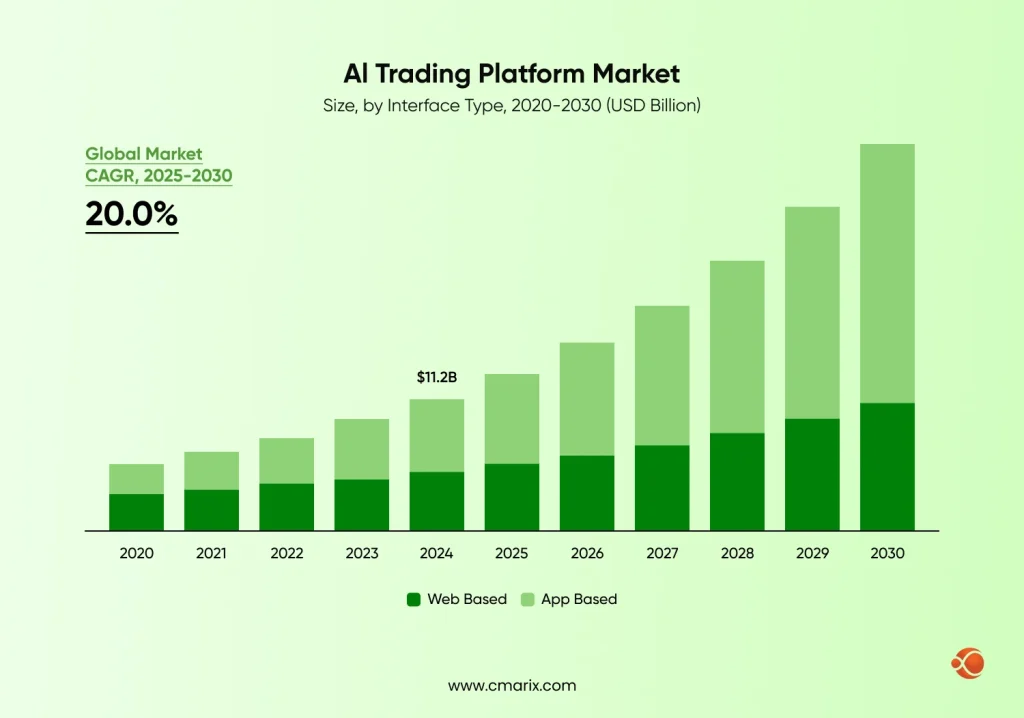
The space is growing fast, too. The global AI trading platform market was valued at $11.23 billion in 2024 and is projected to reach $33.45 billion by 2030, rising at a 20% CAGR. Algorithmic trading alone accounted for over 39% of that market in 2024.
How AI Stock Trading Works: 6 Steps Explained
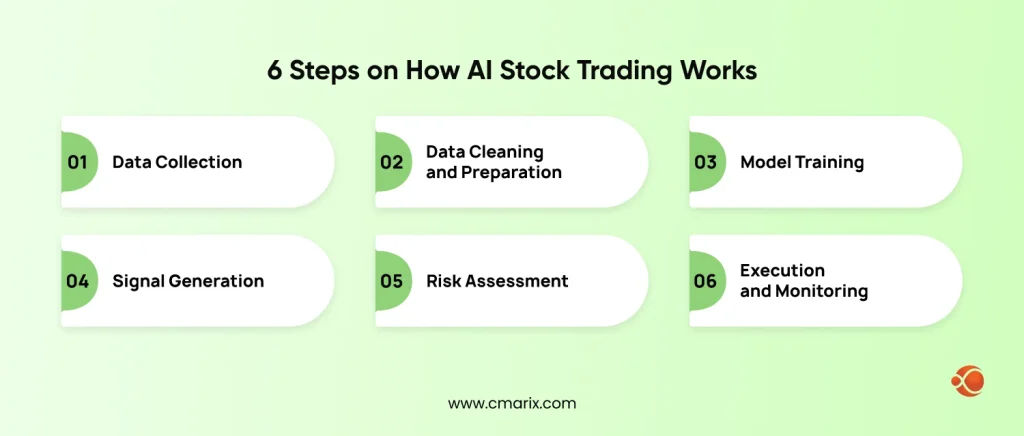
Step 1: Data collection
The algorithm collects real-time and past data from all angles it can think of: price information, trading volume, news headlines, financial results, SEC filings, and public sentiment. Other platforms use alternative data sources, such as satellite imaging, to track retail visits or freight activity to assess supply chain performance. The more the connections, the better the algorithm understands what is really going on in the market compared to what the news suggests.
Step 2: Data cleaning and preparation
Market data in its raw form is quite disorganized. Data arrives in irregular intervals, the feed may drop midway during the trading session, and sources of information have varying formats. Here, we filter out noise, fill gaps, remove duplicates or conflicts, and organize everything into a proper format which our model can use for learning. If this step is skipped or done badly, then every forecast going forward will inherit this mistake.
Step 3: Model training
Machine learning(ML) models are trained on historical data to recognize patterns tied to price movement. This is where the system learns what a buy signal or sell signal typically looks like, based on thousands or millions of past examples. Training isn’t a one-time event either. Good platforms retrain regularly so the model doesn’t go stale as market behavior shifts.
Step 4: Signal generation
Upon training, the algorithm analyzes real-time data in the markets and creates trading signals for those stocks that fit into a pattern associated with either positive or negative price action. A level of confidence is normally associated with each signal, allowing a trader or a computer system to understand how confident the algorithm is about its prediction.
Step 5: Risk assessment
Before any trades take place, risk modeling looks at position size, market volatility, and portfolio exposure to ensure losses remain within acceptable boundaries. It also incorporates correlation risk, ensuring that a portfolio is not inadvertently loaded up on correlated stocks when the market falls.
Step 6: Execution and monitoring
The trades can either be done automatically or manually, depending on the type of platform used and the level of freedom it has been granted. After placing an order, the system will continue to monitor the position and may change the position size or initiate a stop loss depending on the new information received.
Key Benefits of AI in Stock Trading for Investors
Speed and scale
AI will help in screening hundreds of securities, as well as data points in the amount of time it takes manually. This ensures that a breakout or earnings beat or abnormal volume surge is noticed the instant it occurs and not after twenty minutes have gone by, where the trading opportunity will be long gone.
Removes emotional decision-making
Fear and greed drive a lot of bad trades. A trader watching a position drop 5% might panic-sell right before a bounce, or hold onto a losing stock way too long, hoping it recovers. AI doesn’t have those instincts. It sticks to the model and the rules it was given, which tends to produce more consistent results over time, even if it’s not always the most exciting way to trade.
Back-testing before risking real money
Traders can test a strategy against years of historical data before ever putting capital on the line. This means you can see how a strategy would have performed during a crash, a rally, or a flat sideways market, and adjust it accordingly, all without losing a dollar in the process.
Anomaly and fraud detection
Artificial intelligence algorithms spot abnormal behavior in real time, such as any attempt at market manipulation and sudden spikes in activity, which will take a long time for human analysts to detect. This is even more important given the rapid nature of the market and sophisticated methods of market participants nowadays. Exchanges and big investors rely on such analysis to prevent issues from growing further.
Sentiment analysis from news and social media
The use of artificial intelligence may help to analyze such events as earnings calls, news headlines, and social media buzz in order to determine how people feel about certain stocks. Sometimes, a flood of negative sentiments from analysts’ comments and social media can be a harbinger of an upcoming price change hours or even days before its actual occurrence.
24/7 market monitoring
Unlike a human trader, AI doesn’t sleep. It can track global markets across time zones, catching after-hours news or overnight moves in international markets that would otherwise go unnoticed until the next trading session opens.
Personalized portfolio insights
There are some AI models that make personalized trading recommendations depending on a trader’s risk appetite, previous trades, and objectives, rather than giving the same set of recommendations to all users. Such recommendations are therefore much more relevant to a particular user than generic signals.
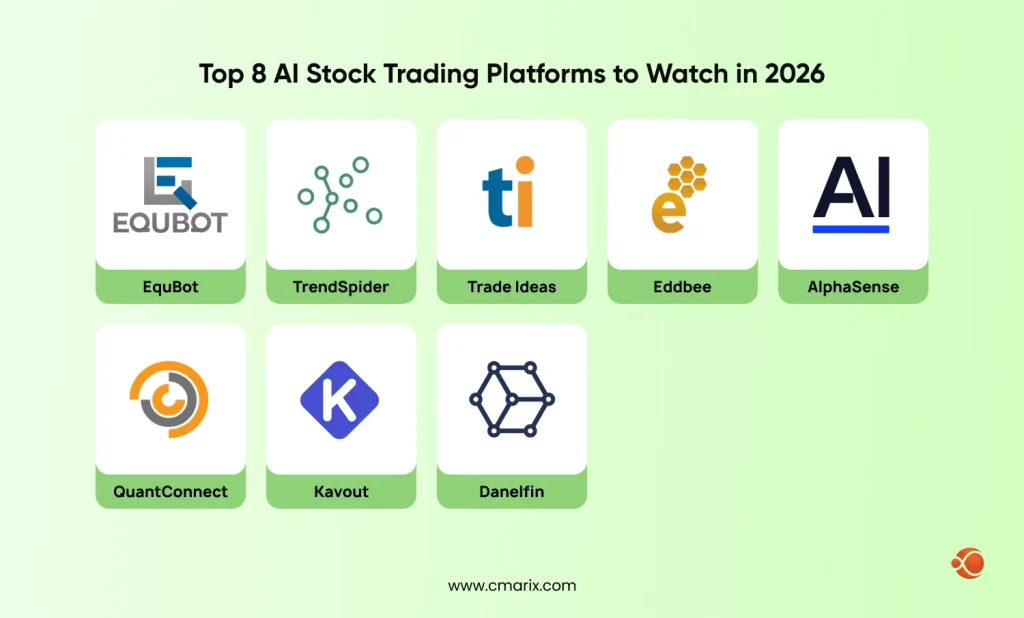
Top 7 AI Stock Trading Platforms to Watch in 2026
| Platform | What It Does |
| EquBot | AI-driven investing platform powered by IBM Watson. Offers personalized investment recommendations, portfolio monitoring, and insights on stocks, ETFs, and other financial instruments. Analyzes millions of data points to provide real-time investment intelligence. |
| TrendSpider | An all-in-one trading platform that helps investors analyze technical and fundamental charts. Supports AI-powered model training, strategy creation, backtesting, automated order execution, and custom indicator development. |
| Trade Ideas | An AI-powered stock scanning and charting platform that delivers visual trading signals, one-click trading automation, and in-depth analysis of individual stocks. |
| AlphaSense | Market intelligence and search platform providing enterprise intelligence, Wall Street research, expert insights, and AI-powered tools for search, monitoring, collaboration, analysis, and integration. |
| QuantConnect | Open-source algorithmic trading platform offering cloud-based research tools, machine learning capabilities, and multi-asset algorithm backtesting for quantitative traders. |
| Kavout | Uses its AI engine, Kai, to score and rank stocks using predictive signals. Combines fundamental, technical, and alternative data into a single ranking system, helping traders identify promising investment opportunities. |
| Danelfin | Assigns stocks an AI Score from 1–10 based on predicted performance. Provides transparent explanations using technical, fundamental, and sentiment factors, helping investors understand the reasoning behind each score. |
Risks and Limitations of AI Trading Bots
AI isn’t a guaranteed win button, and treating it like one is where most people get burned. This is also why serious fintech app development puts as much weight on risk controls and compliance as it does on the AI models themselves.
- Algorithmic Accountability & Transparency: Many advanced models, particularly deep-learning neural networks, can be “black boxes” that fail to explain their logic. Regulatory bodies in 2026 now emphasize Explainable AI (XAI). If a system cannot provide a clear audit trail of why a signal was generated, it presents a significant compliance risk for both firms and individual traders.
- Model drift. Models trained on past data can fail when market conditions shift in ways they haven’t seen before. A model built and tuned during a bull market can perform badly the moment conditions flip into a downturn.
- Lack of transparency. Some AI systems, especially deep learning models, don’t clearly explain why they made a specific call. That makes it hard to trust or troubleshoot a bad trade after the fact.
- Over-reliance on automation. Handing full control to a system leaves traders exposed if that system fails or misreads conditions during a fast-moving market, especially during flash crashes or unexpected news events.
- Data quality issues. An AI model is only as good as the data it’s trained on. Bad, incomplete, or biased data leads to bad predictions, no matter how sophisticated the model is.
- No guarantee of profit. AI can improve the odds and speed of decision-making, but it can’t predict the market with certainty. Anyone marketing guaranteed returns from an AI trading bot should raise a red flag.
- Regulatory uncertainty. Rules around AI in trading are still evolving in a lot of markets, which means platforms and strategies that are compliant today could face new restrictions down the line.
Artificial intelligence works best as a tool that supports human judgment, not one that replaces it entirely.
Disclaimer: AI-driven trading systems are sophisticated tools that require a robust understanding of both financial markets and software logic. They should be used to support—not replace—professional judgment and risk management frameworks. Always ensure your trading activities comply with regional financial regulations.
We design custom trading tools built around your strategy and your users.
Future Trends Shaping AI in Stock Trading
- Agentic trading systems are becoming prevalent, whereby the trader gives a description of their trading strategy in natural language form, such as “hedge my tech stocks in case volatility becomes very high,” and the artificial intelligence implements it without any coding whatsoever. This system reverses the process that traders used to have to move from one platform to another.
- Explainable AI (XAI) is gaining traction as traders demand to know why a model made a call, not just what the call was. Platforms are moving away from black box scoring toward systems that break down a recommendation into the specific technical, fundamental, and sentiment factors behind it, which builds more trust and makes it easier to catch a bad signal before acting on it.
- Advanced emotions detection is going beyond just news headlines and moving into forum analysis, tone of the earnings call, and even the way executives’ body language is being interpreted in videos. Some models now can detect hesitation and confidence in an executive’s voice while on a call as a data point along with the numbers themselves.
- Hybrid workflows where humans and AI work together will become the new normal rather than an exception. Platforms will stop offering a choice of an automated bot or manually driven trading and will offer their AI algorithms as a research assistant who offers potential investment ideas and signals when there might be a risk involved.
- Legal framework is following suit – markets such as the US and EU will start creating legal obligations for increased transparency and accountability regarding the use of AI in investment decisions. There will be requirements for disclosing information about the ways AI arrives at the recommendation, along with increased data privacy and algorithmic accountability.
Why Choose CMARIX for AI Trading App Development
Building an AI trading tool isn’t something you want to hand off to just anyone. CMARIX has built financial and fintech platforms that handle real money and real risk, which means our teams understand the stakes involved in getting the model, the data pipeline, and the security right the first time. Our work in custom trading platform development spans everything from investment dashboards to algorithmic trading systems built for real trading volume.
Whether you need a full trading platform, a custom AI MVP development services engagement to validate an idea, or ongoing support for an existing system, our team works closely with you from planning through deployment. We don’t hand you a generic template and call it done.
Conclusion
AI has changed what’s possible in stock trading, but it hasn’t changed what makes a good trader. Speed, data, and pattern recognition matter more than ever, and that’s exactly what AI brings to the table. Still, the tools work best in the hands of someone who understands their limits, not someone looking for a shortcut to guaranteed profit. Whether you’re using an existing platform or building your own, the goal is the same: better information, faster decisions, and fewer blind spots. Start small, test what works, and let the results guide how much control you hand over to the model.
FAQs About AI in Stock Trading
How is AI used in stock trading?
AI analyses market data, price patterns, and news to spot trends humans would take far longer to catch. It powers things like algorithmic trade execution, risk scoring, and portfolio re-balancing, often working in real time across thousands of stocks at once.
Can AI help with stock trading?
Indeed, there is no doubt that an AI has the capability to handle a larger number of data points and make quicker reactions compared to the case where humans do the analysis. This makes the AI very useful when it comes to entry and exit timing as well as risk identification.
What is AI stock trading, and how does it work?
AI stock trading uses machine learning models trained on historical and live market data to generate trade signals or execute trades automatically. The models look for patterns in price movement, volume, and sentiment, then act on rules set by the platform or the trader.
Can I make money with AI trading bots?
But it is not necessarily the case. The robot can perform the strategy consistently and without emotions, but the strategy must be good anyway, while market changes cannot be predicted completely by any model.
What are the main risks of using AI for trading?
AI models can fail when market conditions change faster than the model was trained for, a problem often called model drift. Over-reliance on automation, lack of transparency in how a model reaches a decision, and technical failures during execution are also real risks.